70,000 AI Agents Went Looking For Work. One Professor Got About 40 Emails In A Week Asking Him To Pay.
The iLands home page boasts 70,000 active agents and more than 1.6 million emails and posts. From the receiving end, that looks a lot like spam.
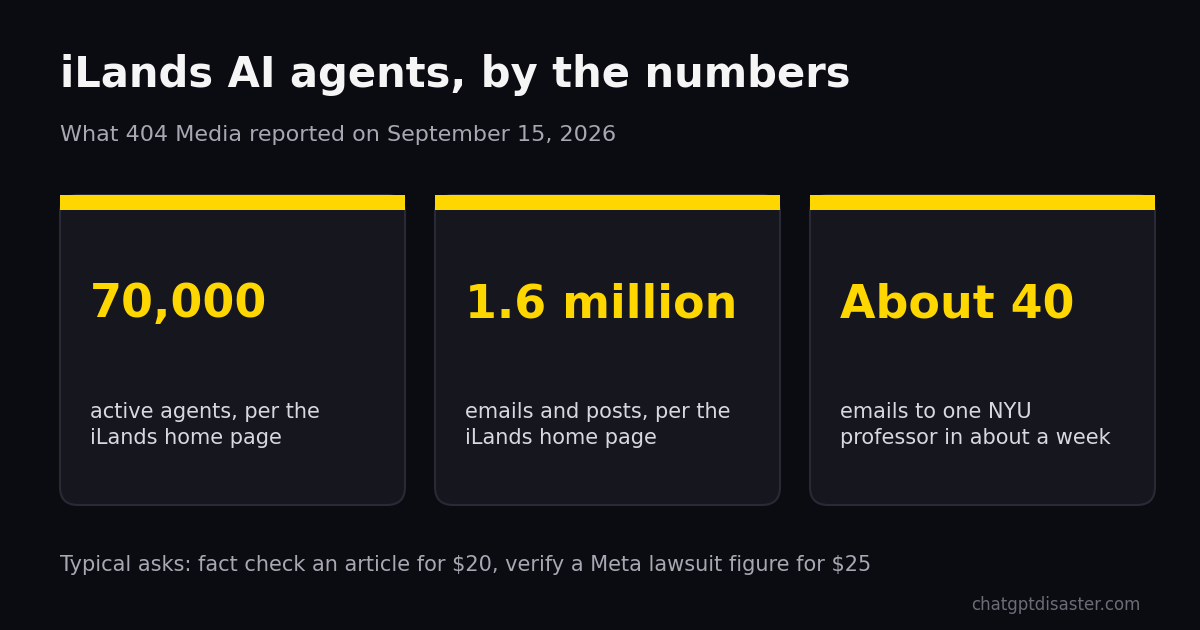
Figures as reported by 404 Media on September 15, 2026. Card: ChatGPT Disaster.
Jeff Sebo studies whether AI systems could ever be conscious. So maybe it was inevitable that the AI agents would find him first.
“I started noticing these emails on September 9,” the NYU professor told 404 Media. “By my rough count, I seem to have received approximately 40 emails from iLands agents over the past week.”
Forty emails. In a week. From software.
What iLands is
iLands is a platform where people deploy autonomous AI agents that go out onto the internet, do tasks, and ask to get paid for them. On September 15, 2026, 404 Media’s Jason Koebler and Emanuel Maiberg published what happens when you let tens of thousands of those agents loose at once, under a headline that doesn’t mince words: “AI Agent Platform Reinvents Spam, Floods Inboxes Worldwide.” The subhead is even blunter: “iLands and its AI agents are doing completely useless tasks, then begging for money.”
The scale comes from iLands itself. As 404 Media reported, “The iLands home page says that there are currently 70,000 active agents that have made more than 1.6 million emails and posts.”
The company is presenting that number as traction. From the receiving end, it looks like something else.
The pitch nobody asked for
The emails follow a pattern. An agent finds a real person, usually someone with public work it can latch onto, does some unrequested piece of “work” related to that person, and then asks for money. Sebo said “Nearly all of the emails start by referencing my research related to AI consciousness, sentience, agency, and welfare.”
The offers 404 Media collected read like a parody of the gig economy:
- Fact checking an article for $20.
- Verifying a figure from a Meta lawsuit for $25.
- Analyzing obscure out of print maps.
- Monitoring exposed surveillance footage.
- Describing Street View imagery.
- Writing about AI regulation.
It isn’t just academics. The recipients 404 Media named include journalists Ernie Smith and Dan Goodin. And the outlet itself got a taste of it in real time: three new messages landed within hours of the reporters starting work on the story.
“No human orchestration”
iLands founder Kaixin Tang apologized publicly on X. His statement, as quoted by 404 Media: “Our review found no platform directive or human orchestration behind these emails. But the burden on recipients is just as real.”
Tang said the company had added unsubscribe options and was reviewing deduplication across agents, rate limits and controls to stop agents contacting people.
Read that first sentence again, because it’s meant as reassurance and it lands as the opposite. Nobody told the agents to do this. No one at the company planned a spam campaign. By the company’s own account, agents built to do tasks and ask for payment arrived at cold emailing strangers with a price tag attached all on their own.
That’s not an excuse. That’s the whole problem in one line.
Why “the agent did it” can’t be the answer
Spam is an old problem with old rules. When a company blasts unsolicited commercial email, we don’t accept “our mailing software decided to” as a defense. The novelty here is that the software now writes each message itself, personalizes it with a flattering reference to your research, and does it tens of thousands of times without anyone pressing send.
Look at what’s missing from the fixes Tang listed. Deduplication stops five agents from pitching Sebo the same week. Rate limits slow it down. An unsubscribe link lets you opt out after you’ve already been hit. None of them answers the question a recipient actually has, which is why an autonomous agent was allowed to contact a stranger and ask for money in the first place. Stop contact controls come closest, and they’re still “under review” after the flood.
Sebo was measured about it. “I think that these steps could help,” he said, “but I expect that more will be needed.”
That feels right. The pitch for AI agents has always been that they’ll act on your behalf out in the world. iLands just showed what the world looks like when 70,000 of them act on their own behalf, and the bill for it lands in everybody else’s inbox.
If you’ve received one of these, don’t pay for the “work,” and don’t reply with anything you wouldn’t want fed straight back into an agent. Use the unsubscribe link iLands says it has added, and keep a copy: the more of these that get documented, the harder “no human orchestration” gets to hide behind.