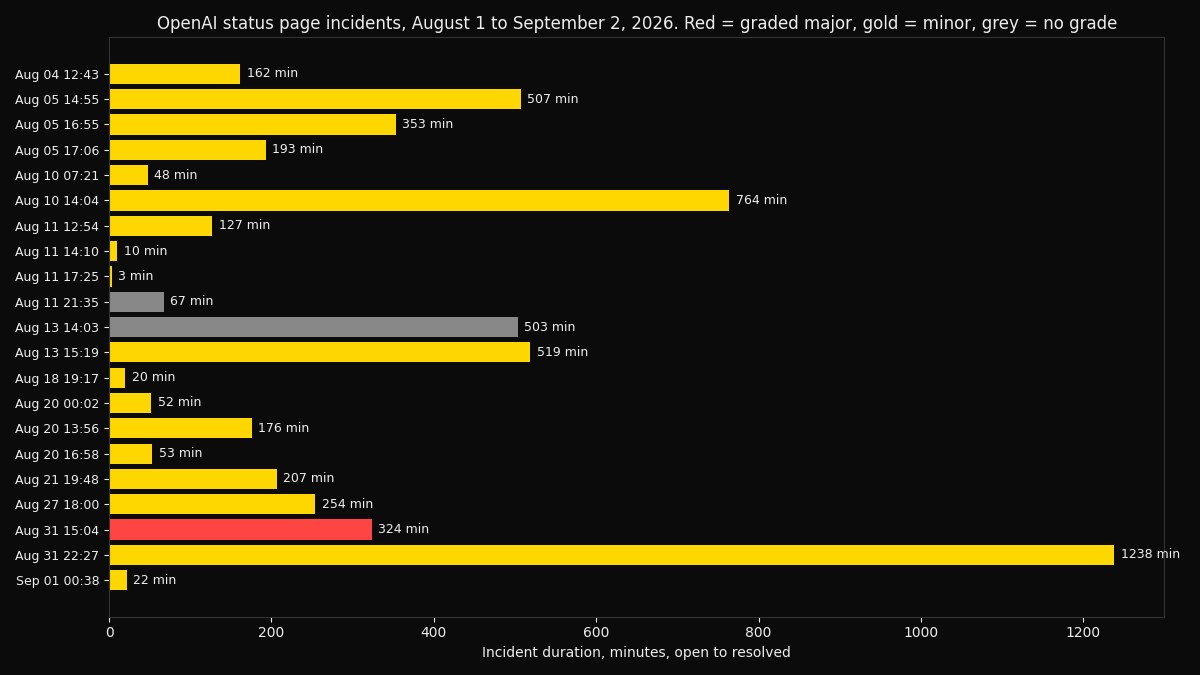
Status pages are written for the people reading them in the moment, which is why nobody goes back and reads them the next day. This one is worth reading the next day.
How The Major Incident Ended
The ChatGPT Work incident opened at 15:04:53 UTC on August 31. Monday’s piece on this site went up at 17:01, with four updates on the board and no mitigation. Here is the rest of the log, verbatim from the status feed.
| Time UTC | Status | Update text |
|---|---|---|
| 17:52 | identified | User across multiple subscription plans may be unable to start or continue tasks in ChatGPT Work. We are continuing work on implementing a mitigation. |
| 19:29 | identified | User across multiple subscription plans may be unable to start or continue tasks in ChatGPT Work. We are continuing work on implementing a mitigation. |
| 20:01 | monitoring | We have applied a mitigation and are monitoring recovery. |
| 20:28 | resolved | All impacted services have now fully recovered. |
Eight updates in total. Six of them said identified. The sentence “User across multiple subscription plans may be unable to start or continue tasks in ChatGPT Work” was posted four times, at 16:02, 17:01, 17:52 and 19:29, with the only variation being whether the word “We” appeared once or twice. A mitigation was applied at 20:01, four hours and fifty seven minutes after the incident opened. Resolution came 27 minutes after that.
324 minutes. Five hours and twenty four minutes during which paying customers on multiple plans could not use a product that has the word Work in its name. That is the incident OpenAI graded major, and the grade was correct.
Then The Night Shift
At 22:27:56 UTC, one hour and fifty nine minutes after the major incident resolved, a new one opened: Elevated latency in the Responses API. The Responses API is the developer product, the thing companies build on. Here is its full log.
| Time UTC | Status | Update text |
|---|---|---|
| Aug 31 22:27 | identified | We have identified an issue causing elevated latency for some Responses API requests. We are working on implementing a mitigation. |
| Aug 31 23:13 | monitoring | We have applied a mitigation and are monitoring recovery. |
| Sep 1 01:46 | monitoring | We have applied the mitigation and are monitoring the recovery. |
| Sep 1 15:15 | identified | We have identified elevated latencies impacting Responses API on the US endpoint. |
| Sep 1 17:36 | identified | We are implementing the mitigation. |
| Sep 1 18:09 | monitoring | We have applied the mitigation and are monitoring the recovery. |
| Sep 1 19:05 | resolved | All impacted services have now fully recovered. |
Read the fourth row. The incident had been in monitoring for sixteen hours, which on a status page means the fix is in and we are watching it work. At 15:15 UTC on September 1 it went backwards to identified, with a new sentence about the US endpoint. The mitigation that was applied at 23:13 the night before had not held, or had not covered the endpoint that mattered, and it took another two hours and twenty one minutes to apply a second one.
Total elapsed, open to resolved: 1,238 minutes. Twenty hours and thirty eight minutes. The longest incident OpenAI has logged since the 764 minute error rate incident of August 10, and nearly four times the length of the one it graded major. Severity: minor.
The Grade Is Not About Time
Monday’s piece made this point with the August 20 login outage, 52 minutes and graded minor. This week makes it with arithmetic.
| Incident | Product | Duration | Grade |
|---|---|---|---|
| ChatGPT Work errors and latency | ChatGPT, paid plans | 324 min | major |
| Elevated latency in the Responses API | API, developers | 1,238 min | minor |
| Increased error rates, August 10 | ChatGPT | 764 min | minor |
| Chatgpt.com is down, all signups and logins, August 20 | Everyone | 52 min | minor |
Whatever the grade measures, it is not duration and it is not breadth. A twenty hour degradation of the product that businesses pay per token to build on is minor. A total login outage is minor. Five hours of the enterprise workspace product being unavailable is major. The one consistent reading is that the grade tracks which customers are complaining loudest to whom, and that is a reasonable thing for a company to track. It is not what a status page is for.
August, Closed
With the Work incident resolved, August 2026 is complete on the OpenAI status page. Monday’s count of 19 incidents and 68.9 hours was measured with the major incident still running. The final figures:
| August 2026 | Final |
|---|---|
| Incidents opened | 20 |
| Cumulative incident time | 5,579 minutes, 93.0 hours |
| Graded major | 1 |
| Graded minor | 17 |
| No grade | 2 |
| Hours in the month | 744 |
Ninety three hours of open incidents in a 744 hour month is 12.5 percent of the month with something on the board. That is not the same as 12.5 percent downtime, because most of those incidents touched one product or one plan, and because the Responses API incident alone contributes 20.6 of the 93 hours while its first four hours were in August and the rest in September. Counted strictly by the minutes that fell inside August, the month is closer to 76 hours. Either number is the worst since this site started keeping the ledger in July.
September is two days old. It has one incident so far, 22 minutes of elevated errors for Free and Go plans at 00:38 UTC on the first, and the tail of one that started in August. The ledger continues.